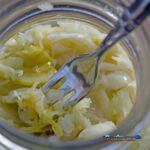
My Go-To Recipe For Sauerkraut
Easy homemade recipe for sauerkraut with just cabbage and salt. Tangy, crunchy, and perfect for sandwiches, sides, or snacking straight!
Servings 16
Calories 14kcal
Useful Equipment:
Ingredients
- 2-3 lbs cabbage (about 1 medium-large head)
- 4 to 5 teaspoons kosher salt (1.5 to 2 teaspoons per pound of cabbage)
Instructions
Weigh the Cabbage
- Use a kitchen scale to weigh your cabbage. You’ll need about 1½ to 2 teaspoons of salt per pound of cabbage.
Prepare the Cabbage
- Remove and discard any damaged or dirty outer leaves.
- Set aside one clean outer leaf (you’ll use it later).
Clean and Core
- Cut out the core, then rinse the cabbage thoroughly, making sure water gets between the leaves.
Shred the Cabbage
- Finely slice the cabbage with a sharp knife.
Salt the Cabbage
- Place the shredded cabbage in a large bowl. Sprinkle with the measured salt and toss to coat evenly.
Massage and Brine
- Let it rest for 15 minutes, then massage firmly with your hands for about 5 minutes. You should feel the cabbage soften, and it will start to release a briny liquid (your fermenting brine).
Pack into a Jar
- Transfer the cabbage and the liquid (brine) into a clean, wide-mouth glass jar.
- Press down firmly with a spoon or muddler to remove air pockets.
Add the Brine and Weight
- Pour the remaining brine from the bowl over the cabbage.
- Cut the reserved cabbage leaf to fit the diameter of the jar and place it on top (Optional).
- Add a fermentation weight (or small weighted object) to keep everything submerged.
Top Off If Needed
- If the cabbage isn’t fully covered by liquid, add a 2% brine (1 teaspoon salt per 1 cup of water) until fully submerged.
Seal and Set Aside
- Screw on a plastic lid (metal can corrode). Place the jar in a shallow dish to catch overflow. Store at room temperature (65–75°F) out of direct sunlight to ferment.
Fermentation Time
- Let ferment for 2 to 6 weeks, depending on your taste. Start tasting after 2 weeks. If it’s not tangy enough, continue fermenting for another week and taste again.
Refrigerate When Ready
- Once it reaches your preferred flavor, move the jar to the refrigerator. Cold storage slows fermentation and keeps the sauerkraut fresh.
Notes
- Extra brine (2% salt solution = 1 tsp salt per 1 cup water), in case needed. You may not need it. Sometimes I do, sometimes I don’t.
I did not like the way a food processor or mandolin slices the cabbage. Yes, they work faster but tend to cut the cabbage up like confetti. I recommend hand-slicing the cabbages; it gives a much better texture and lasts longer. - If you truly love sauerkraut, I highly recommend investing in fermentation jars. They hold a lot of kraut and are designed especially for fermentation with an airlock to let the gases escape. This will eliminate any mess.
- Label jars with dates if you have trouble remembering when you started fermentation and when you stopped it.
For best results, store in a cool, dark space while fermenting. Avoid direct sunlight. - Look for signs of successful fermentation, including bubbling, a tangy smell, and a softening texture.
- Discard if you see mold above the brine (Never eat kraut exposed to air with mold).
Nutrition
Serving: 0.25cup | Calories: 14kcal | Carbohydrates: 3g | Protein: 1g | Fat: 0.1g | Saturated Fat: 0.02g | Polyunsaturated Fat: 0.01g | Monounsaturated Fat: 0.01g | Sodium: 592mg | Potassium: 97mg | Fiber: 1g | Sugar: 2g | Vitamin A: 56IU | Vitamin C: 21mg | Calcium: 23mg | Iron: 0.3mg
Did you try this recipe? We’d love to hear your thoughts! Give it a star rating and leave a comment below to let us know how it turned out for you. If you’d like, share a photo of your dish on Instagram, don’t forget to mention @TheMountainKitchen or use #TheMountainKitchen!