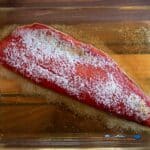
Smoked Salmon Dry Brine
Discover an easy, dry brine recipe for smoked salmon. Simple ingredients, easy-to-follow steps, and delicious results every time!
Servings 10
Calories 286kcal
Useful Equipment:
Ingredients
- 2-3 pounds wild-caught salmon
- 1 ½ cups brown sugar
- ½ cup kosher salt
- Optional: honey or maple syrup to brush on as a glaze at the end of smoking.
Instructions
Step 1: Prepare the Salmon
- Begin by inspecting the salmon fillet for pin bones. Starting at the tail end, run your fingers along the center of the fillet toward the head, feeling for any bones. If you detect any, use clean needle-nose pliers or fish tweezers to carefully remove them.
Step 2: Apply the Dry Brine
- In a mixing bowl, combine the brown sugar and kosher salt. Use a whisk to mix well. The exact amount of dry brine will depend on the size and number of salmon fillets. You need enough to coat the fish thoroughly. Place a thin layer of the brine mixture at the bottom of a baking dish or a large plastic container. Lay the salmon fillet on top, skin-side down, and then cover it completely with the remaining brine mixture, making sure it is well-coated. Cover the container and refrigerate for 6-8 hours.
- The curing time will vary depending on the thickness of the salmon fillet. For thinner fillets, 4 to 6 hours is usually enough, while thicker pieces may require up to 6-8 hours. Be cautious not to over-brine; this causes the salmon to be too salty.
- After the curing period, remove the salmon from the brine, rinse it under cool running water to eliminate excess salt and sugar, and pat it dry with paper towels.
Step 3: Air-Dry the Salmon to Form the Pellicle
- After brining, it's important to develop a pellicle—a slightly tacky, glossy layer on the salmon's surface that helps smoke adhere better. To do this, remove the salmon from the brine and rinse it gently under cool running water. Pat the fillet dry with paper towels and place it skin-side down on a rack over a sheet pan or a platter. Leave the salmon uncovered in the refrigerator for at least 4 hours, or overnight, to allow the pellicle to form.
Step 4: Prepare the Grill and Manage the Temperature
- Smoking salmon requires maintaining a consistently low temperature between 150-200 degrees F. Begin by lighting about a dozen charcoal briquettes in a chimney starter. Once the coals are ready, arrange them for indirect heat by placing them into a charcoal basket or pushing them to one side of the grill. Add a chunk or handful of cherry wood chips to the coals for flavor. Preheat the grill or smoker to approximately 170 degrees F, adding more charcoal if necessary to achieve the desired temperature.
Step 5: Smoke the Salmon
- To prevent the salmon from sticking during grilling, lightly oil the grill grates using a paper towel before placing the fish. Position the cured and dried salmon fillet skin side down on the cooler side of the preheated grill. This helps ensure even cooking and minimizes sticking. Alternatively, a perforated grilling pan can be used to allow even smoke and heat distribution, which is especially useful for skinless fillets.
- Cover the grill with the lid and maintain a low, steady temperature. Avoid rapid temperature increases, as this can cause a white protein called albumin to surface, which is harmless but can affect the salmon's appearance. Forming the pellicle and carefully monitoring the grill temperature can help minimize this.
- Smoke the salmon for about 1 to 2 hours, adding more coals and wood as needed. Use an instant-read thermometer to check the salmon's internal temperature; it should reach 120 degrees F during cooking. Now is the time to brush on a glaze like honey or maple syrup if you choose to do so. The salmon is done when it flakes easily and reaches an internal temperature of 135-145 degrees F in the thickest part. Remove from the grill or smoker.
- After smoking, allow the salmon to rest at room temperature for 10 to 15 minutes before serving. Alternatively, after the fillet has cooled completely, wrap it tightly in plastic wrap and refrigerate it overnight. This is normally what David and I like to do. This resting period enhances the melding of smoky flavors into the fish.
Notes
- Use a 3:1 ratio for the dry brine mixture of 3 parts brown sugar to 1 part kosher salt.
- For added flavor, you may incorporate optional ingredients such as garlic powder, black pepper, or crushed bay leaves into the brine mixture.
- The thickness of the fish will determine the amount of time you dry brine the fish as well as how long you smoke it. Thinner fillets like sockeye salmon require less brining and less smoking than thicker fillets like King Salmon.
Nutrition
Calories: 286kcal | Carbohydrates: 32g | Protein: 23g | Fat: 7g | Saturated Fat: 1g | Polyunsaturated Fat: 3g | Monounsaturated Fat: 2g | Cholesterol: 62mg | Sodium: 5718mg | Potassium: 601mg | Sugar: 32g | Vitamin A: 45IU | Calcium: 45mg | Iron: 1mg
Did you try this recipe? We’d love to hear your thoughts! Give it a star rating and leave a comment below to let us know how it turned out for you. If you’d like, share a photo of your dish on Instagram, don’t forget to mention @TheMountainKitchen or use #TheMountainKitchen!