
Grinding your own meat at home is a great way to control the quality and freshness of your ground beef. This guide will show you how to grind meat like a pro.

I’m here to tell you grinding hamburger meat is not overrated.
David and I finally broke down and bought the meat grinding attachment of our mixer to grind our hamburger meat. We have made burgers from fresh ground meat several times, and the results were DELICIOUS! Store-bought ground beef is convenient, but grinding your hamburger meat for burgers, meatballs, chili, or meatloaf is a new level.
Today, I thought I would share what we learned with you. I’m not saying that grinding meat a handful of times makes us experts. Still, we can offer insight into the process based on our recent experiences and share some information we have researched about grinding hamburger meat.
So let’s jump into this grinding hamburger meat, shall we?
Grinding Hamburger Meat 101
The best part about grinding hamburger meat yourself is having total control over what goes into it. Not to mention, you get the freshest quality meat possible. I recently read a disturbing article about additives and ammonia that the USDA allows and considers acceptable for human consumption. We’re talking about additives; who knows how long the product had been frozen before grinding it?
Quality is important to us, and quality makes a difference in how your food tastes. Making a great hamburger starts with the meat selection.
#1 MEAT SELECTION: What’s in the Grind
Fat equals juiciness and flavor, people! This is why the lean-to-fat ratio in ground beef is critical for locking in moisture and for great beef flavor. If you want a good burger, 80/20 is definitely the best blend when grinding hamburger meat. 20% fat is ideal for cooking your burger anywhere from medium-rare to medium-well.
Of course, you may be like my mama and want your beef well done; if you like your burger well done, then maybe you should be more like 40% fat. If you want it to be rare, reduce the fat content. Trust me, you don’t want a lot of unrendered fat in your burger.

When putting together your burger cuts of meat, you should always be concerned with the quality of the meat. Sometimes, that means paying a little more money. High-end cuts of meat, such as porterhouse or filet mignon, are not necessary for really good burgers. If that suits your fancy, by all means, go right ahead; don’t forget to leave money in the budget for good wine and beer. Am I right?!?!
No matter what meat selections you make, always remember to keep a good 80/20 ratio.
Our Choice of Meat Cuts
For our burgers, we used a third each of Chuck, New York Strip, and Sirloin Tip the first time we ground our burgers and Chuck, Brisket, and Sirloin Tip for the second batch. We used the New York Strip as the first grind because of our limitations in the meat case. Brisket versus New York Strip was the main difference between our two burger blends. There was a slight difference in the burger’s richness and a textural difference because the brisket tends to add a nice graininess to the meat we liked.
- SIRLOIN TIP: Sirloin tip comes from the thigh part of the round or hip of the cow’s leg. It’s an economically lean horseshoe-shaped cut with a robust beefy flavor.
- BRISKET: Brisket comes from the belly of a cow. It has a moderate to low-fat content and is beefy because it is a hard-working muscle. It makes a nice, rich burger.
- CHUCK-EYE: Chuck is an amazing beef cut from a cow’s shoulder. It’s marbled throughout with delicious, juicy fat, and a cow has a lot of it compared to other cuts. If you used nothing else, always use chuck. It has the most flavor and guarantees you to create a top-notch burger.

#2 THE MEAT GRINDER: The right tool for the job
Even if you do not have a meat grinder at home, you don’t have to miss out on an opportunity to grind your meat. Some folks use a food processor to do the trick. Honestly, I have never been able to get a food processor to treat food as it should or how I want it to, so I do not recommend it. I would use a manual hand-operated grinder before using a food processor.
A manual grinder is another option for grinding your hamburger. This is the same type of meat grinder used for centuries. It is still available today at reasonable prices and lasts forever. Perhaps a grandparent has one in the cabinet that hasn’t been used in decades?
You could also ask your butcher to grind up a meat selection of your choice, but where’s the fun in that?
You can purchase a relatively inexpensive grinding attachment on Amazon for around $50 if you have a KitchenAid stand mixer. We are pretty impressed with it. The food grinder attachment is easy to assemble, dismantle, and clean. It has a very consistent grind with a coarse or fine-grind metal die. You will want to use the coarse-grinding die to grind hamburgers.

#3 GRINDING THE MEAT: How to grind chunks of meat into burgers
Using a sharp knife, remove any silverskin, cartilage, and bones. We had to stop our first batch of ground hamburger about midway through to clean out the die. The silverskin is tough and will not grind.
Cut the meat into 1 to 1 ½-inch cubes.
It is up to you whether or not to chill the meat. Most articles I have read say to chill the meat well after cutting it. Some even go as far as to put the meat into the freezer for about 20 to 30 minutes before grinding. In our experience, the meat was still pretty chilly from the refrigerator, and we did not bother. David worked fast to cut it up, and the meat ground up nicely. However, it is important to remember that the warmer the meat gets, the softer it becomes, and the fat becomes pulpy and mealy when it’s ground.

SAFETY FIRST! – Tips on Food Safety
Food-related illnesses can be life-threatening! Cold meat is important for food safety. Please follow the following guidelines when handling and grinding meat.
- Meat should remain cold at all times. Don’t let it sit out while you go outside to talk to your neighbor or something.
- Ensure you wash your hands and clean the surface before and after grinding the meat.
- When you finish grinding the meat, clean the grinder thoroughly with hot, soapy water, even before it goes into a dishwasher.
- If you do not have a dishwasher (Why not?!?), submerging the grinding mechanism parts in hot boiling water to sanitize them may be a good idea.
Test Your Meat For Flavor
The best way to test the flavor of your efforts is to form a small ground meat into a patty and fry it in a skillet. Sprinkle a little salt to help bring out the flavor.
Look for the following characteristics:
- Brown/Roasted
- Buttery
- Fatty
- Juiciness
Storing and Freezing Ground Beef
Store unused ground meat in an airtight zip-top bag inside the fridge for two days before freezing.
Once you have experimented with ringing meat and honed in on your favorite mixture, you can produce large batches to freeze. You can freeze fresh ground beef for 4-6 months, sealed tightly in a freezer bag or even longer with a vacuum sealer.
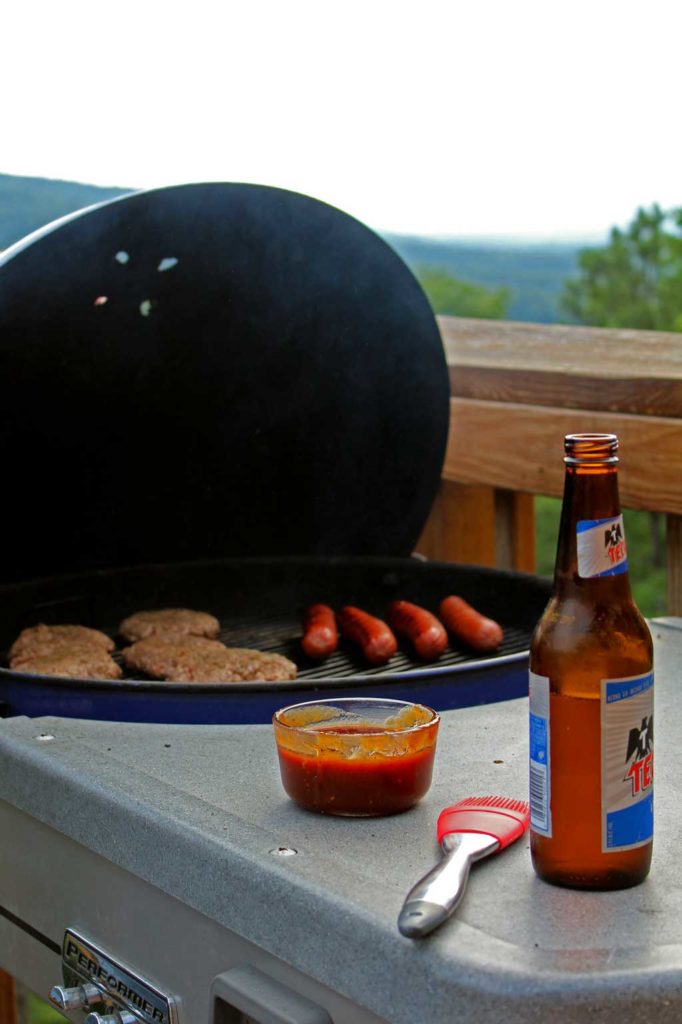
Crack open a beer and fire up the grill! That’s what David and I do with fresh-ground, good ol’ American cheeseburgers! David especially enjoys his famous BBQ Bacon Cheeseburgers (we will share that recipe with you eventually) and slathers with Classic Barbecue Sauce. We’ll even throw on a few hot dogs, too!
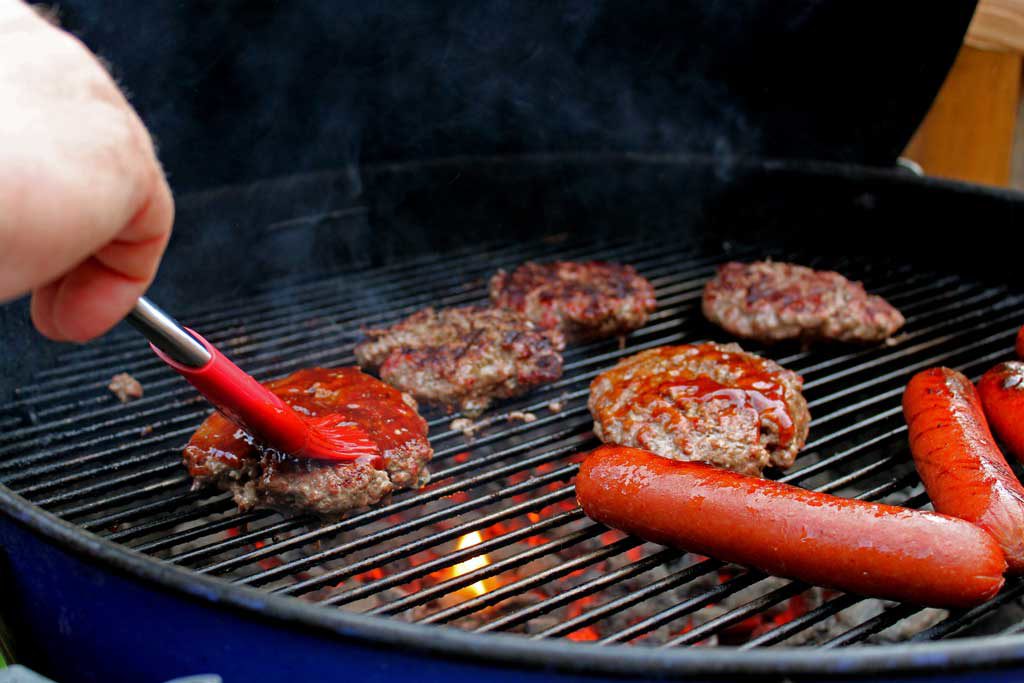
When the patties were about done, David cheesed them all up.


Recipes That Use Ground Beef
Here are some of our favorite recipes that use ground beef:
Burger blending is an art that involves a lot of trial and error. Take control of what you consume and try grinding your own blend.
Have fun grinding your meat, and enjoy!





Tasty Eats Ronit Penso says
Couldn’t agree more! I can’t bring myself to buy store ground meat. I call it “mystery meat”…:)
The Mountain Kitchen says
You’re exactly right, Ronit!!
Julie is Hostess At Heart says
Now I’m hungry! We love combining pork with beef too, especially for meatloaf.
The Mountain Kitchen says
That sounds wonderful! Yes, a good meatloaf should always have pork. ?
givememeatloaf says
Um, duh – now I have to do this for a meatloaf! I need to get the attachment but looks totally worth it. Dave is going to love this!
The Mountain Kitchen says
It’s a great investment Annie! Hurry!!! 🙂
Chuck says
I love grinding my own meat. I use a top sirloin, brisket and short rib blend and it is amazing. Thank you for sharing.
The Mountain Kitchen says
You are welcome. We are glad you like this post. Grinding your own meat is so much better, Chuck! Thanks!
Mike says
What do you use for your blend and your ratio. I always wanted to use short ribs but didn’t know what to use and how much.
The Mountain Kitchen says
Hi Mike! We use an 80/20 mixture of sirloin, brisket, and chuckeye. Short ribs would be a good substitute for the brisket.
Kynthia says
I don’t have a dishwasher because I enjoy hand washing dishes. It really is that simple. One phone call and I’d have a top of the line dishwasher delivered and installed. Waste of space and money, for me.
My burger mix is 2 chuck 1 flatiron 1 sirloin and 1 bacon (in pounds). Lots of bold beefy flavor, that touch of bacon gives it more flavor and especially moisture. The ground mixture is pressed into 1/3 lb patties and frozen for future handling. If you are going to be grilling these, melt a shallow dish of ghee, dip the patty into the butter (both sides) and you will get that steakhouse flavor.
Sometimes I take 1 gallon freezer bags, add 1 lb of my mix then flatten the meat out to where it’s a thin sheet filling the entire freezer bag. Thaws on the double quick.
The Mountain Kitchen says
I love that you put bacon in yours. Awesome, Kynthia! Thanks for those tips!
Ei LL says
Thank you Debbie and David! We purchased a 1/4 pasture-raised cow, but the ground meat is too lean. I ordered 10 lbs of extra fat to add to my ground meat, to render fat, and to make pemican. I just purchased the meat grinder attachment to my Kitchen Aid mixer and was pleased to read your delightful article. The scenic photo of David grilling on the deck reminds me of the years we lived in southwest Virginia when our children were growing up. Thanks for The Mountain Kitchen!
The Mountain Kitchen says
You’re very welcome. Happy to help! Thank YOU! 🙂
Stevfen says
If I purchase the three cuts of beef, how do I determine an 80/20 ratio?
The Mountain Kitchen says
The 80/20 ration is an inexact science for the home cook. A chuck roast is naturally 80/20 with fat marbling throughout the meat. We chose sirloin tip, brisket and chuck eye because of flavor and texture. There is plenty of fat within them visually although they may not be exactly 80/20. We recommend visually comparing it to what you see as 80/20 in the store. If it looks on the lean side, then grind in some extra fat sliced from a fatty cut of meat or add in more lean if it looks to fatty. Alternatively, cut the lean from the fat and then grind, but that seems like a lot of trouble. Hope this helps!